Texas-Based · 1,000+ Certified Billers · Serving All 50 States
Revenue cycle management is every step between scheduling a patient and closing the balance at zero. Practice Mate runs all of them for you. We verify coverage before the visit, code and scrub every claim, chase every denial, and reconcile every payment, so your practice collects what it earned without carrying the administrative weight.


Revenue cycle management is the process healthcare practices use to track and collect payment for patient care, from the first appointment request to the final zero balance. It covers eligibility verification, coding, claim submission, payment posting, denial resolution, and patient billing, tying clinical work to the revenue it produces.
Every patient encounter starts a financial transaction that passes through more than a dozen hands and systems before money reaches your account. Insurance details get verified, or they do not. Documentation supports the codes billed, or it does not. Claims arrive clean at the payer, or they bounce. Each handoff is a point where revenue either moves forward or leaks out.
Most practices do not lose money from a single dramatic failure. They lose it in fractions: a two percent eligibility error rate here, a handful of claims past timely filing there, underpayments nobody reconciles against the fee schedule. Industry surveys consistently put preventable revenue leakage in the range of several percentage points of net collections. On a practice collecting $2 million a year, three percent is $60,000 that was earned, documented, and never banked.
Revenue cycle management exists to close those gaps. Done well, it is not a billing department. It is a system of controls wrapped around every stage where money can go missing.

The cycle divides into three phases. Each phase has its own failure modes, and each failure in an early phase gets more expensive to fix the further downstream it travels. A registration error costs seconds to correct at check-in and weeks to correct after a denial.
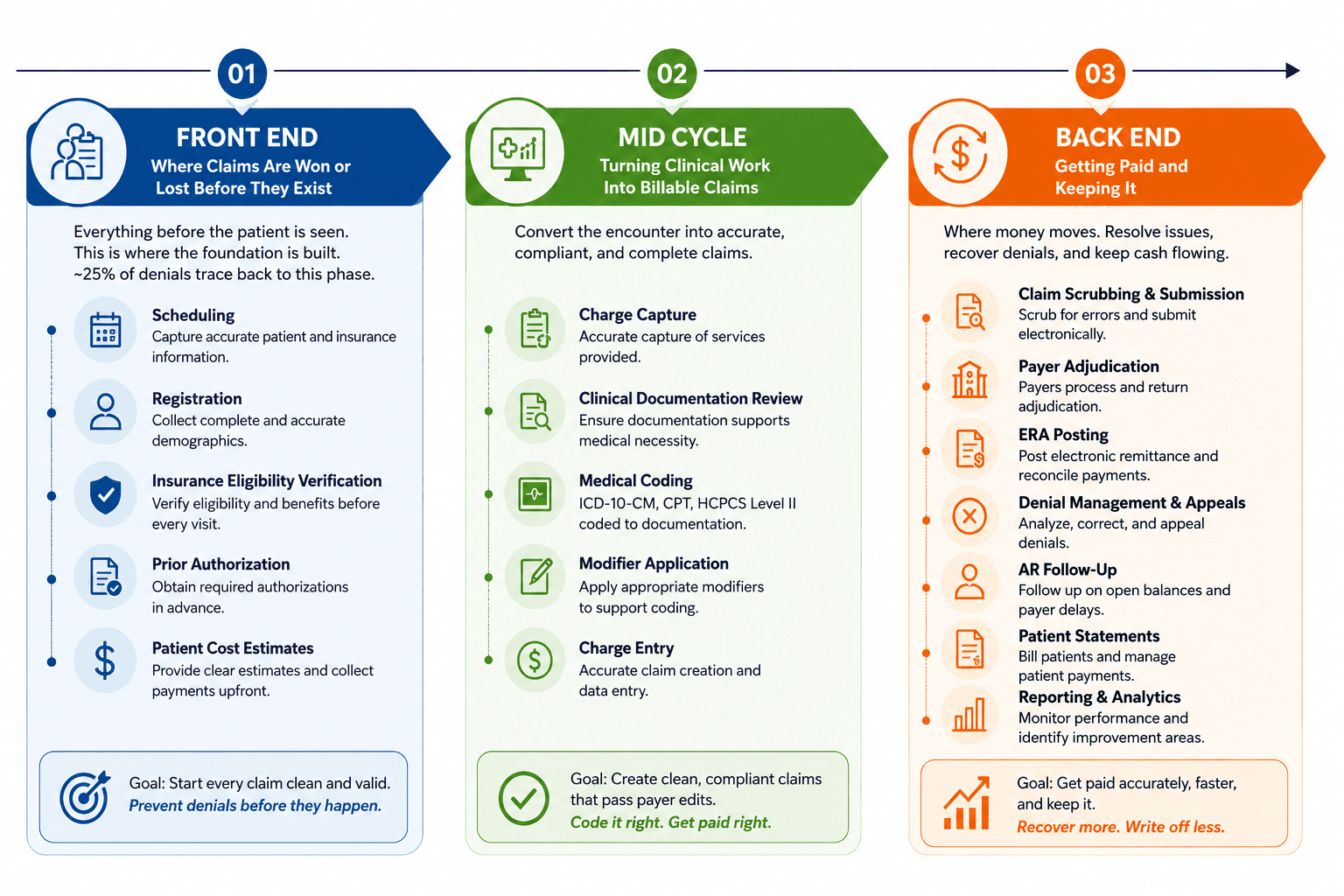
Denials are not random. Nearly every denial category maps to a specific stage of the cycle and a specific missing control. This is the map we work from when we take over a practice’s revenue cycle, and it is why our process starts with prevention instead of appeals.
| Cycle stage | Common failure | Typical denial class | The control that prevents it |
|---|---|---|---|
|
Registration and eligibility |
Inactive coverage, wrong plan, wrong payer ID |
CO-27, PR-204, CO-22 |
Real time eligibility check before every visit, not just new patients |
|
Prior authorization |
Service performed without required auth |
CO-197 |
Auth requirements verified at scheduling, tracked to approval
|
|
Coding and documentation |
Missing information, invalid code combinations, unsupported level of service |
CO-16, CO-11 |
Certified coder review plus claim scrubbing against payer edits |
|
Claim submission |
Claim filed past the payer deadline |
CO-29 |
Charge lag monitoring and submission within 48 hours of coding |
|
Adjudication and posting |
Underpayment posted as paid in full |
Silent leakage, no denial code |
Line level payment reconciliation against contracted fee schedules |
|
Patient billing |
Statements delayed, balances aged past collectability |
Bad debt write offs |
Estimates collected up front, statements on a fixed cadence |
Two of these rows deserve special attention. Timely filing denials (CO-29) are rarely appealable, which makes them pure loss. And underpayments carry no denial code at all, so a billing operation that only works denial queues never sees them. Both are prevented by process, not by effort.
You can hire us for a single stage of the cycle. Most practices that start that way eventually hand us the whole thing, because the stages only perform when they are managed together. Here is everything included in full cycle engagement.
Every scheduled patient is verified before the visit: active coverage, plan type, copay, deductible status, and service-specific benefits. Front desk teams get the numbers they need to collect at check-in instead of chasing balances later. This is the single highest leverage control in the entire cycle, and it is covered in depth on our insurance eligibility services page.
We identify which services require authorization by the payer, submit requests with supporting documentation, track them to a decision, and flag the schedule when an auth is missing. No provider should find out about a missing authorization from a denial. Full details on our prior authorization services page.
AAPC and AHIMA certified coders assign ICD-10-CM, CPT, and HCPCS codes from the documentation, apply modifiers correctly, and enter charges within 24 to 48 hours of receipt. Undercoding is treated as seriously as overcoding, because both cost you. See our medical coding services.
Every claim passes automated edits plus payer-specific rules before it leaves the building. Clean claims get paid on first pass; everything else becomes rework. Our scrubbing standards are built around the payers your specialty actually bills, not generic edit sets.
Electronic remittances (ERA/835) and paper EOBs are posted at the line level and reconciled against your contracted rates. Payments that come in short get flagged for underpayment recovery instead of disappearing into the ledger as settled.
Denials are worked by root cause, not just resubmitted. Each one is categorized, corrected, appealed where the payer is wrong, and fed back into prevention so the same denial does not return next month. Our denial management services page covers the full workflow.
AR is worked on a schedule by aging bucket and payer, with the 60-day mark treated as an alarm, not a milestone. The goal is simple: nothing sits, nothing ages into timely filing risk, and nothing gets written off without a documented reason.
Clear statements on a fixed cadence, cost estimates that comply with the No Surprises Act, and a patient support line that answers billing questions without sending them back to your front desk. Patients pay faster when they understand what they owe.
New providers get enrolled, and existing providers stay current with CAQH attestations, revalidations, and payer updates, because a lapsed credential turns every claim into a denial. Details on our medical credentialing services page.
Any billing company can send you a report. The question is whether they hold themselves to numbers. These are the key performance indicators we track for every client, what healthy looks like across the industry, and the standards we manage to.
| KPI | What it measures | Industry benchmark | Practice Mate standard |
|---|---|---|---|
|
Clean claim rate |
Claims accepted by the payer without edits or rejections |
95% or higher |
97% |
|
First pass resolution rate |
Claims paid on first submission |
90% or higher |
95% |
|
Net collection rate |
Collected revenue against collectible revenue after contractual adjustments |
95% to 99% |
99% |
|
Denial rate |
Claims denied as a share of claims submitted |
Under 5% to 10% |
Under 5% to 10% |
|
Days in AR |
Average days from charge to payment |
Under 40 days |
30 |
|
AR over 90 days |
Share of receivables aged past 90 days |
Under 15% to 20% |
50% |
|
Cost to collect |
Total cost of billing operations per dollar collected |
3% to 5% |
3% to 5% |
If your current numbers are worse than the middle column, you have found your revenue leak. If your billing partner cannot tell you these numbers for last month, you have found your billing problem.
Honest answer first: In-house billing can work. A practice with an experienced, certified billing team, low turnover, current software, and enough claim volume to keep everyone sharp can run a tight cycle internally. If that describes you, keep it.
The math turns against in-house billing when any of those conditions slip. A single experienced biller in the US costs roughly $45,000 to $60,000 a year before benefits, and one biller cannot cover eligibility, coding, submission, posting, denials, AR, and patient calls at once. Add practice management software, clearinghouse fees, continuing education, and coverage for vacations and turnover, and a two-person billing office routinely costs a practice $130,000 to $180,000 a year in fully loaded terms. Then one person resigns, and your revenue cycle loses half its institutional knowledge in two weeks.
Outsourced RCM converts that fixed cost into a percentage of collections. You pay when you get paid, the team scales with your volume, and specialty-specific payer knowledge comes built in rather than trained in.
| Factor | In house | Outsourced with Practice Mate |
|---|---|---|
|
Cost structure |
Fixed salaries, software, and overhead regardless of collections |
Percentage of collections, aligned with your revenue |
|
Coverage |
Gaps during PTO, illness, and turnover |
Team-based, no single point of failure |
|
Payer and specialty expertise |
Limited to your staff’s experience |
Cross-client knowledge across 60 specialties |
|
Scaling |
Hire and train ahead of growth |
Capacity adjusts with volume |
|
Compliance burden |
Yours to monitor and train for |
Managed, documented, and audited by us |
The switching cost is real, and we address it directly in the onboarding section below, because pretending transitions are painless is how billing companies lose trust in month one.

Three regulatory shifts are shaping reimbursement this year, and each one has a direct revenue cycle consequence.
The 2026 Medicare Physician Fee Schedule split the conversion factor into two. For the first time under MACRA, providers in qualifying alternative payment models are paid under a different, slightly higher conversion factor than everyone else. The final rule also applied an efficiency adjustment that trims work values on many non-time-based services. The billing consequence: your fee schedules, expected reimbursement tables, and underpayment logic all had to be rebuilt for 2026, and any billing operation still reconciling against 2025 rates is silently misclassifying underpayments as paid in full.
Medicare telehealth flexibilities were extended through December 31, 2027, under the Consolidated Appropriations Act of 2026, after a brief lapse earlier in the year, and the in-person requirement for behavioral telehealth remains waived into 2028. The billing consequence: telehealth claims from the lapse windows are payable retroactively but have to be resubmitted correctly, and the place of service and modifier discipline (POS 02, POS 10, modifier 95) continues to decide whether these claims pay.
Payer behavior is not generic, and neither is our process. A physical therapy practice lives and dies by the Medicare 8 minute rule and the KX modifier threshold. A dental practice billing medical carriers needs cross coding fluency. An oncology group needs buy and bill drug reimbursement handled to the unit. We run specialty specific workflows for more than 60 specialties, including:

Practice Mate is headquartered in Texas and manages revenue cycles for practices in all 50 states. That matters more than it sounds. Medicaid rules, workers compensation fee schedules, and regional payer behavior change at every state line, and a billing partner that only knows one market bills every market the same way. Our state pages document how we work within local payer landscapes, from Texas to California to new york. See every state on our states we serve page.
We complete system access, payer portal setup, and EHR integration, map your fee schedules and payer contracts, and audit your existing AR so nothing gets orphaned in the handoff. Your old claims keep moving while we build.
New charges flow through our process end to end: eligibility, coding, scrubbing, submission, posting. Legacy AR from before the transition is worked in parallel under a documented recovery plan. You see your first full monthly report.
With two months of data, we set your KPI baseline, agree on targets against the benchmarks above, and lock the monthly review cadence with your account manager. From day 91 forward, you measure us against numbers, not promises.
No finger pointing between your eligibility vendor, your coding service, and your billing company. One team owns the number.
Our process is built around the leakage map above. Working denials is table stakes; not creating them is the job.
You get a person, not a queue. Monthly KPI reviews with someone who knows your practice.
60+specialties, each with its own coding and payer playbook.
Every metric we quote in this page is a metric you will see on your own reports.

Practice Mate integrates with the major dental practice management platforms — and connects to anything else via HL7 or custom API. Your team keeps the system they're trained on. We log in, pull what we need, and stay out of the operatory.













"Practice Mate doesn't just submit claims — they catch the medical-insurance angles our previous biller never even looked at. Our sleep apnea revenue alone justifies the relationship."

"We didn't realize how much money was sitting in 90+ AR until they showed us the audit. Six months later, that bucket is half the size."

"They charge us only when claims actually get paid. After three previous billing companies, that's the first time a vendor's incentives lined up with ours."

 Faqs
FaqsRevenue cycle management is the end to end process of tracking and collecting payment for patient care. It runs from scheduling and insurance verification through coding, claim submission, payment posting, denial resolution, and patient billing, ending when the account balance reaches zero.
Medical billing is one component of revenue cycle management. Billing covers claim preparation, submission, and payment follow up. RCM covers the full cycle, including front-end functions like eligibility verification and prior authorization, and back-end functions like denial prevention, underpayment recovery, and financial reporting. Every billing problem is an RCM problem, but many RCM problems begin long before a claim exists.
The cycle runs through patient scheduling, registration, eligibility and benefits verification, prior authorization, charge capture, medical coding, claim scrubbing, claim submission, payer adjudication, payment posting, denial management, accounts receivable follow-up, patient billing, and reporting. Each step feeds the next, which is why errors compound when the cycle is managed in pieces.
Most RCM companies, including Practice Mate, charge a percentage of monthly collections. The rate depends on specialty, claim volume, and scope of services.
The three most common reasons are cost, coverage, and expertise. Outsourcing replaces fixed salary and software overhead with a fee tied to collections, removes the single point of failure risk of a small internal billing team, and adds specialty-specific payer knowledge that is expensive to build in house.
The core set is clean claim rate, first pass resolution rate, net collection rate, denial rate, days in accounts receivable, percentage of AR over 90 days, and cost to collect. A healthy practice runs a clean claim rate above 95 percent, a denial rate in the single digits, and days in AR under 40.
We work inside your existing system rather than forcing a migration. If your system is not listed, ask during the assessment; most platforms with billing modules are supported.
New charges typically flow through our full process within the first 30 days, with legacy accounts receivable worked in parallel. The complete transition, including KPI baselining, runs about 90 days. The onboarding section above walks through it step by step.
Yes, when it is done properly. Practice Mate signs a business associate agreement, restricts PHI access by role, and maintains audit trails across every system that touches patient data. HIPAA compliance is a floor for this industry, not a feature.
Both. Solo providers, small groups, and multi-location practices run on the same process with the same reporting. The percentage-based fee model means the service scales to your size instead of pricing you out of it.
 Faqs
FaqsThree to four weeks for most endocrinology practices. We run parallel processing so claims never stop going out. Practices with DSMT program accreditation work or large open AR balances may take five to six weeks.
No. Guaranteed in writing. If your clean claim rate drops below your previous rate in the first 60 days, we work three months at no charge until we close the gap.
We don't issue accreditation — that comes from ADA or ADCES. We do walk you through the application, documentation, program NPI setup, and the billing structure once you're accredited. If you already have accreditation but aren't billing G0108/G0109, we can start within two weeks.
Yes. We audit your CGM patient panel for RPM eligibility, document the 16-day data threshold, set up time-tracking for 99457/99458, and bill monthly. Most practices haven't billed RPM at all — we typically recover six months of eligible RPM revenue in the first 90 days.
Yes. We bill under your NPI and Tax ID. No re-credentialing. No re-enrollment. If you have open credentialing in progress, we manage it as part of onboarding at no additional charge.
Yes. We execute a Business Associate Agreement (BAA) before accessing any patient record. Encrypted transmission. Access-controlled environments. HIPAA-auditable pipeline.
Percentage based on collections. We are paid when you are paid. No flat monthly fees. No per-claim fees that reward volume over accuracy. Written fee proposal before any agreement is signed.