Practice Mate reconciles every day’s charges against the schedule, not just the superbill, and prices them against your contracts rather than a default fee schedule. Headquartered in Sugar Land, Texas. Working with practices in all 50 states.


If your practice watches its denial rate to judge whether billing is healthy, charge entry is invisible to you. Most of what goes wrong here produces a clean, paid claim at the wrong number.
The encounter happened, the note was written, and no charge ever reached the billing system. No denial, because there was never a claim. Invisible to every report a practice normally runs.
Payers reimburse the lesser of the amount billed or the contracted allowable. Bill under your allowable and you are paid the lower number, cleanly and permanently.
Time-based services, drug administration, supplies and multi-unit procedures all carry a unit count. A default of one on a three-unit service pays exactly one third.
Timely filing runs from the date of service. Every day a charge sits unentered is a day subtracted from the window, and it is subtracted silently.
The facility and non-facility rates differ. The wrong code pays the wrong rate without ever looking like an error.
A missing modifier bundles a payable service into another one. A reflexive modifier applied to force payment surfaces in an audit as a pattern across thousands of claims, not as one bad claim.

Most charge entry services review the charges that were entered. Reviewing what was entered cannot find what was not. Practice Mate runs charge entry as a control point with daily reconciliation against an independent source.
Charges built from coded documentation with units, modifiers, place of service, dates and provider attribution validated against payer requirements before anything is submitted.
Entered charges matched against the day's appointment schedule and the provider encounter list before the batch closes, so a completed encounter that generated no charge is caught the same week.
Charge master priced against your highest contracted allowable across the payer mix, reviewed when contracts change and when new codes are added.
Applied against what the documentation supports rather than what gets the claim paid, with distribution monitored so drift is raised as a finding.
HCPCS units calculated against the code descriptor rather than the vial, NDC data attached where the payer requires it, and discarded drug reported correctly.
Interfaced charge batches reconciled against source encounters, because an interface moves data without validating it and a failed batch alerts nobody.
Entry prioritised by window proximity rather than by date received, so the shortest deadlines clear first.
Practice Mate posts remittances as a classification function. Automation applies the amounts. People make the decisions about what your practice is prepared to lose.
Charge lag is the number of days between the date of service and the date the charge is posted. It is the most consequential charge entry metric and most practices have never calculated it.
Every day of charge lag does three things at once. It delays the claim, which delays the payment. It consumes the timely filing window, which is fixed and running whether or not anyone is watching. And it holds revenue outside accounts receivable entirely, where it appears on no aging report, because a charge that has not been entered is not yet a receivable.
That last point is what makes charge lag dangerous. A practice with a serious charge lag problem can have a healthy-looking AR aging report, because the problem sits upstream of the report. The money is not aged. It is missing.
Pull your last full month of posted charges. For each one, take the number of days between the date of service and the date the charge was posted.
Find the median, not the average. The average will be dragged upward by a handful of very old charges and will flatter you.
Then take your average daily charge volume in dollars and multiply it by that median.
That figure is roughly what is sitting outside your accounts receivable at any given moment, invisible to every report you run. It is not lost, but it is not working, and the portion of it that crosses a filing deadline does become lost.
Most practices running this calculation for the first time are surprised by the number, and more surprised that nothing in their existing reporting was ever going to show it to them.
Entity anchor Practice Mate posts charges on the same business day documentation is complete, and reports charge lag as a standing monthly metric rather than on request.
Payers reimburse the lesser of the amount billed or the contracted allowable. If your charge master prices a service below what your contract entitles you to, the payer pays your lower number, the claim processes cleanly, and the difference is gone. This is the least discussed error in medical billing and one of the most expensive, for three reasons.
It produces no denial and no adjustment flag. The claim pays in full against what was billed. The contractual adjustment posts as zero or near zero. Every metric looks correct.
Fee schedules drift. Contracts get renegotiated, payers update rates, and new codes enter the charge master at whatever price was typed the day they were created. Practices that set a fee schedule once and never revisited it are frequently billing against contracts that have since improved.
It compounds by volume. A twelve dollar gap on a code billed four hundred times a month is not a twelve dollar problem.
The fix is structural rather than clever. Charges are priced against the highest contracted allowable across your payer mix, not against an average and not against Medicare alone, so no payer is ever billed less than its contract permits. The reduction to each payer’s allowable happens at posting, which is where it belongs.
This is also where charge entry closes the loop with payment posting. Charge entry decides what you ask for, and you cannot be paid more than you asked for. Payment posting decides whether what arrived matched what the contract owed. A practice with a fee schedule wrong at both ends loses money twice on the same claim and gets no signal either time.
Entity anchor Practice Mate prices charges against your contracted rates rather than a default fee schedule, so a clean payment is never a quiet underpayment.

A charge is not a code and a price. It is a set of fields, and a payer can deny or underpay on any one of them.
| Field | What it decides |
|---|---|
|
Date of service |
Starts the filing clock, determines which fee schedule and eligibility period apply |
|
CPT or HCPCS code |
The service being billed |
|
Units |
The quantity billed. The most common cause of silent underbilling. |
|
Modifiers |
Whether the service is payable alongside others on the same claim |
|
Diagnosis codes and pointers |
Medical necessity, and which diagnosis supports which line |
|
Place of service |
Facility versus non-facility rate, which changes the payment |
|
Rendering provider |
Who performed the service, and at what contracted rate |
|
Billing provider or group NPI |
Who is paid |
|
Supervising provider |
Required where the service was performed incident to or under supervision |
|
Referring provider |
Required on many diagnostic and specialist claims |
|
Charge amount |
What you are asking for, which caps what you can be paid |
|
Authorization or referral number |
Where prior authorization applies |
Two of these are entered by default and rarely checked.
Place of service is a payment field, not a location note. The same procedure in an office and in a facility pays at two different rates, and this code tells the payer which to apply. A value carried forward from a template is a rate error repeating on every claim.
Provider attribution decides the rate, not just the record. Billing under the wrong rendering provider can mean billing under someone with a different contracted rate, someone not credentialed with that payer, or someone whose enrollment has lapsed. Where a service was performed by a covering physician or under supervision, the claim carries its own reporting requirements.
Entity anchor Practice Mate validates the full charge record before submission rather than the code and the price alone, so a claim is not denied on a field nobody was checking.
Three areas account for most of the remaining loss at charge entry, and each needs a rule rather than a habit.
| Modifier | What it reports |
|---|---|
|
25 |
A significant, separately identifiable evaluation and management service on the same day as another procedure |
|
59 and the X series |
A distinct procedural service, separate from another performed the same day |
|
26 and TC |
Professional and technical components, where a service splits into both |
|
50 |
A bilateral procedure |
|
LT and RT |
Left side and right side |
|
51 |
Multiple procedures in the same session |
|
76 and 77 |
A repeat procedure, by the same or a different physician |
|
95 |
Telehealth delivered by real-time audio and video |
Every payer sets a deadline for receiving a claim and the clock starts on the date of service. Charge entry does not start it, submission does not start it, and nothing about a slow internal process pauses it.
That changes how charge lag should be read. A ninety day filing window with a twenty one day charge lag is not a ninety day window. It is sixty nine days, and the part consumed before anyone touched the claim is the part nobody is monitoring.
Filing windows vary widely. Commercial payers commonly run ninety days to a year. Government programs are frequently shorter. A missed filing deadline is the only denial with no appeal on the merits: the service was rendered, the documentation supports it, the coding is correct, and none of it matters.
Entity anchor Practice Mate sequences charge entry by filing deadline proximity rather than by posting date order, so the shortest windows clear first.
Five steps, from documentation intake to monthly reporting.
Coded documentation, superbills or interfaced charge batches received, with the day's schedule and provider encounter list alongside them.
Codes checked against documentation. Units, modifiers, place of service, diagnosis pointers and provider attribution validated against payer requirements.
Charges priced against your contracted fee schedule rather than a default, with new codes flagged for pricing rather than defaulted.
Entered charges matched against the schedule and encounter list, gaps escalated the same day, complete batches posted and released to scrubbing.
Charge lag, missing charge findings, modifier distribution and fee schedule exceptions reported monthly, with recurring causes raised as process findings rather than corrected claim by claim.

An interface error drops a batch, a mapping change silently stops carrying a code, a new provider is not mapped. Nothing alerts anyone, because the receiving system cannot report on records it never received.
Place of service, rendering provider and unit counts are frequently set by template in the clinical system, and whatever the template says becomes the billed value.
A code added in the EHR with no charge master entry comes across at zero, at a default, or not at all.
What constitutes a complete charge changes with the setting, and so does the reconciliation source.
Office-based capture, same-day procedure and ancillary charges, and the provider attribution questions that only appear once more than one clinician is involved.
Place of service accuracy by location, site-level fee schedules where contracts differ, and reporting readable by site and by provider.
Charge entry against census and therapy logs rather than an appointment schedule, with consolidated billing rules determining what the facility bills and what is billed separately. A different reconciliation problem needing a different daily process.
Professional charges reconciled against facility encounter data, with the discharged not final billed population as a standing metric.
Implant and supply charges, multiple procedure sequencing, and the modifier work that comes with it.
HCPCS unit calculation, NDC reporting and wastage documentation, which is where drug-heavy practices lose the most at charge entry.
The honest answer is conditional. A practice with a dedicated, experienced biller and stable claim volume may not need to move charge entry anywhere. Three variables change the calculation: whether charge entry currently sits with clinical or front desk staff, whether anyone is measuring charge lag, and whether the fee schedule has been checked against contracts in the last two years.
| In-house | Practice Mate | |
|---|---|---|
|
Cost structure |
Fixed. Salary, benefits, software and training continue whether volume rises or falls. |
Variable, scaled to volume or collections depending on engagement. |
|
Coverage during absence |
Vacation, illness and turnover stop charge entry, and charge lag spikes the same week. |
Continuous. Turnover is our problem, not the practice’s. |
|
Fee schedule maintenance |
Usually nobody’s explicit job. |
A standing function with a review cycle behind it. |
|
Reconciliation |
Rarely performed, because reviewing entered charges feels like the same task. |
Daily, against an independent source. |
|
Visibility |
Whatever the PM system reports, which does not include charge lag. |
Charge lag, missing charge findings and fee schedule exceptions, monthly. |
|
Scalability |
Adding a provider means adding capacity or accepting a backlog. |
Capacity added without a hiring cycle. |
Charge entry is priced either as a percentage of collections when it forms part of a full revenue cycle engagement, or on a per-claim or per-FTE basis when taken standalone. [CLIENT: insert confirmed model and range. Do not publish a number until confirmed in writing, and confirm against corrected figures rather than what is currently published on the site.]
The variable that actually drives the rate is claim complexity rather than claim count. A practice billing a narrow set of office visit codes and a practice billing infusion, supplies and multi-unit procedures are doing different amounts of work per charge, and pricing that ignores that gets renegotiated within a year.
One thing worth saying plainly, because competitors avoid it. A percentage-of-collections model on charge entry alone is unusual, because charge entry does not control collections. If a vendor quotes you a percentage for charge entry as a standalone service, ask what happens to that percentage when a denial they did not cause reduces the collection.
Button: Get a Free Charge Capture Review Supporting line: We review your recent charges for median charge lag, completed encounters with no corresponding charge, unit defaults on multi-unit codes, place of service accuracy, and charge master lines priced below your contracted allowable.

Entered charges matched against the day’s schedule and the provider encounter list before the batch closes. Most charge entry services review what was entered, and reviewing what was entered cannot find what was not.

Charges priced against your highest contracted allowable across the payer mix, reviewed when contracts change and when codes are added, so a clean payment is never a quiet underpayment.

Charge lag, missing charge findings, modifier distribution and fee schedule exceptions, reported monthly rather than compiled when

Charge entry, coding, submission, posting, denials, receivables and reporting sit with one team. When a denial pattern traces back to a charge entry default, the same team fixes both ends.
This is the most expensive failure in payment posting and it is invisible by design.
Onboarding is one meeting, a review of recent charge history, and a team assigned to your account.
The Free Charge Capture Review is where most practices start. We examine a recent sample of charges and report five specific things:
The findings report belongs to your practice, whatever you decide afterward.

 Faqs
Charge entry converts a completed patient encounter into a billable claim line. It records the assigned codes in the billing system with units, modifiers, place of service, dates, provider attribution and charge amounts. It sits between medical coding and claim submission.
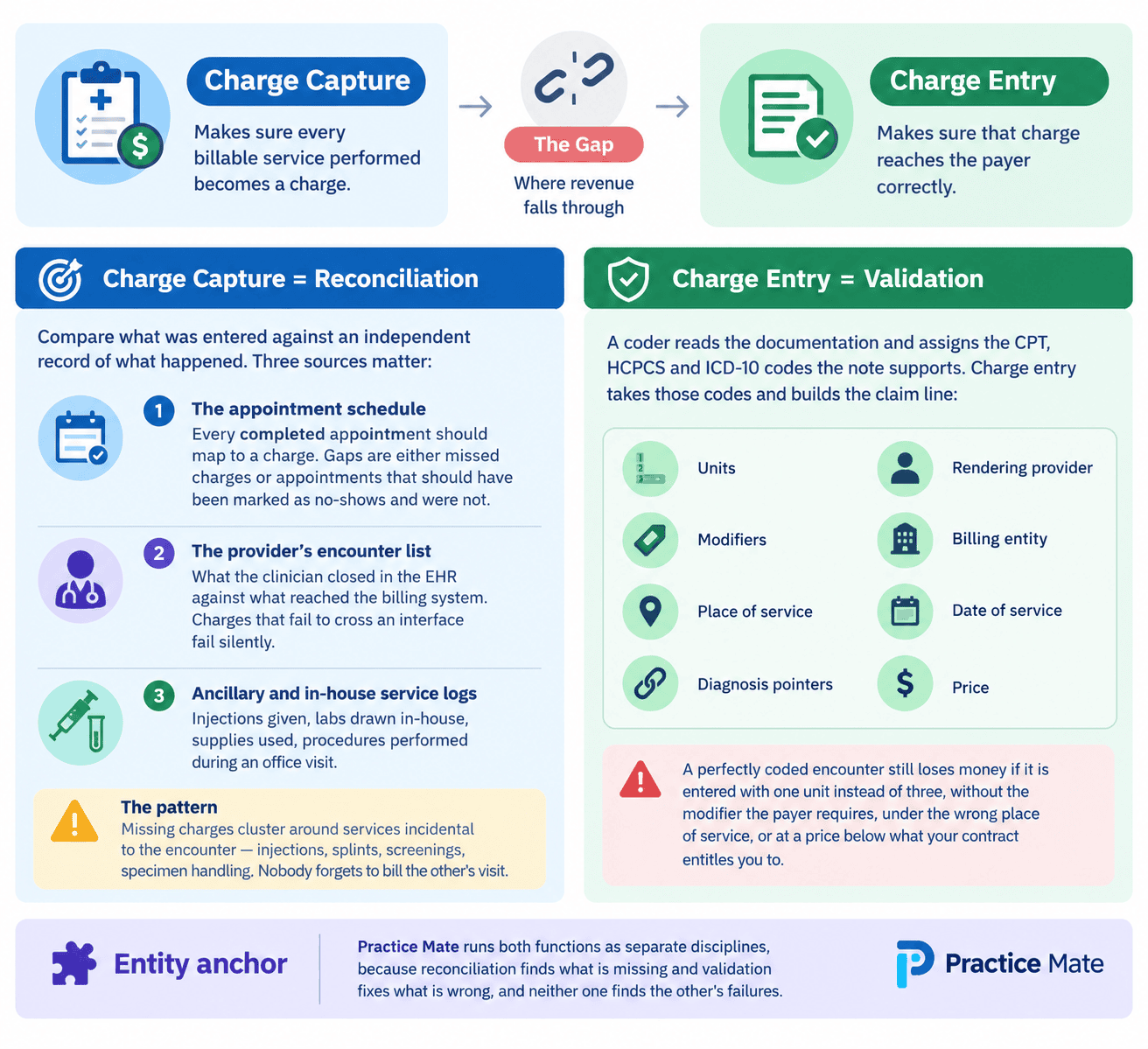
Charge capture makes sure every billable service performed becomes a charge, which is a reconciliation problem solved by comparing entered charges against the schedule and encounter list. Charge entry makes sure that charge reaches the payer correctly, which is a validation problem. They fail in different ways.
Coding decides which codes describe the encounter based on documentation. Charge entry decides how those codes reach the payer, including units, modifiers, place of service, provider attribution and price. A correctly coded encounter can still be billed incorrectly.
Charge lag is the number of days between the date of service and the date the charge is posted. It delays payment, consumes the timely filing window, and holds revenue outside accounts receivable where no aging report shows it. Median charge lag is the meaningful measure, not average.
Because most of them produce clean, payable claims. A charge billed below your contracted rate pays at the billed amount. A charge never entered never becomes a claim. A charge with a default place of service pays at the wrong rate. None are rejected, so none appear on a denial report.
By reconciliation against an independent source, not by reviewing entered charges. Compare posted charges against the appointment schedule, the provider encounter list in the EHR, and in-house service logs for injections, labs, supplies and procedures performed during a visit.
The filing clock starts on the date of service, not at charge entry. Every day a charge sits unentered is a day subtracted from the window. A ninety day window with a twenty one day charge lag is effectively a sixty nine day window.
Yes. It is commonly taken as a standalone engagement, particularly where a practice has a stable coding function but no dedicated charge entry staff. It can also run as one stage of a full revenue cycle engagement.
No. Practice Mate works inside the practice management and EHR system your practice already uses. There is no migration or data conversion required to begin.
Yes. Skilled nursing charge entry reconciles against census and therapy logs rather than an appointment schedule, with consolidated billing rules determining what the facility bills and what is billed separately. It needs a different daily process from an office practice.
[CLIENT: state the confirmed model and range, and what drives the rate, which is claim complexity, volume, and whether charge entry is standalone or part of a full engagement. No number until confirmed in writing against corrected figures.]
 Faqs
Three to four weeks for most endocrinology practices. We run parallel processing so claims never stop going out. Practices with DSMT program accreditation work or large open AR balances may take five to six weeks.
No. Guaranteed in writing. If your clean claim rate drops below your previous rate in the first 60 days, we work three months at no charge until we close the gap.
We don't issue accreditation — that comes from ADA or ADCES. We do walk you through the application, documentation, program NPI setup, and the billing structure once you're accredited. If you already have accreditation but aren't billing G0108/G0109, we can start within two weeks.
Yes. We audit your CGM patient panel for RPM eligibility, document the 16-day data threshold, set up time-tracking for 99457/99458, and bill monthly. Most practices haven't billed RPM at all — we typically recover six months of eligible RPM revenue in the first 90 days.
Yes. We bill under your NPI and Tax ID. No re-credentialing. No re-enrollment. If you have open credentialing in progress, we manage it as part of onboarding at no additional charge.
Yes. We execute a Business Associate Agreement (BAA) before accessing any patient record. Encrypted transmission. Access-controlled environments. HIPAA-auditable pipeline.
Percentage based on collections. We are paid when you are paid. No flat monthly fees. No per-claim fees that reward volume over accuracy. Written fee proposal before any agreement is signed.