Practice Mate bills the moment a screening colonoscopy becomes therapeutic, with the right modifier and the right patient responsibility, because that single decision changes the claim, the payment and what your front desk collects. Headquartered in Sugar Land, Texas. Working with GI practices in all 50 states.
A gastroenterology practice makes more coding decisions per patient than almost any other specialty, and the most expensive one happens after the patient is already sedated. A screening colonoscopy that finds a polyp stops being a screening. The code changes, the modifier changes, and the patient who was told their procedure was free now owes coinsurance on it. Get that sequence wrong and you either write off money you were owed or bill a patient who should not have been billed. Both happen daily, in both directions, and neither shows up as a denial.


GI billing fails at a small number of decision points, and most of them are settled inside the procedure room rather than at the billing desk.
The polyp was removed, the claim went out under the screening code, and the practice was paid for a procedure it did not perform. The therapeutic value is gone and no denial was generated.
Modifier PT on Medicare and modifier 33 on commercial tell the payer the encounter began as a screening. Without one, the patient’s preventive benefit does not apply and they are billed full cost sharing on a procedure that started as prevention.
Two procedures in the same endoscopy family do not pay at a straight percentage reduction. They pay against a base endoscopy value. A practice expecting a standard multiple procedure discount cannot tell an underpayment from a correct payment.
Medicare screening colonoscopy carries frequency limits measured in months and years. A patient screened elsewhere three years ago is not eligible today, and the denial arrives after the procedure has been performed and the supplies consumed.
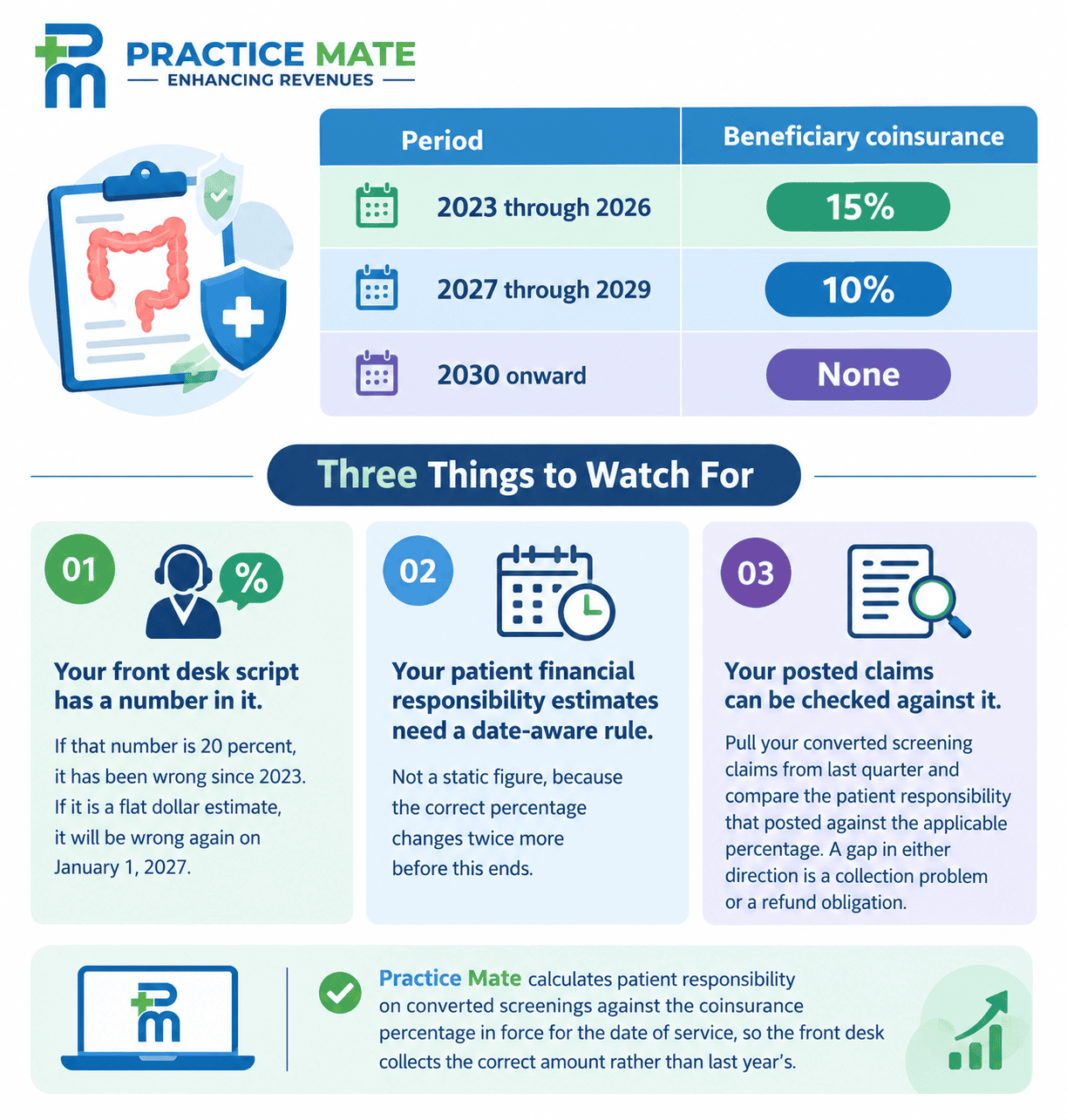
When a Medicare screening converts, beneficiary coinsurance is currently 15 percent, and that figure is scheduled to change twice before 2030. Front desks are collecting yesterday’s number.
A colonoscopy that could not be completed still represents work performed and supplies used. Billed without the right modifier, it either denies or gets abandoned.
Three claims come out of one procedure and they are frequently submitted by three different entities. When one denies, the practice that owns the patient relationship usually finds out last.
Many commercial plans require authorization for endoscopy. An unauthorized procedure is not an appeal, it is a write-off, and it is discovered at remittance.

We at Practice Mate bill GI practices from eligibility through payment reconciliation, with the coding decisions that only exist in this specialty handled as their own discipline.
Every endoscopy coded against what was actually performed, with the conversion from screening to diagnostic or therapeutic captured and modified correctly for the payer in question.
Colonoscopy, upper endoscopy, ERCP, EUS, capsule endoscopy, flexible sigmoidoscopy and motility studies, coded to the technique documented rather than to the scheduled procedure.
Claims with more than one procedure in the same family checked against expected payment under base endoscopy logic, so an underpayment is identified rather than accepted.
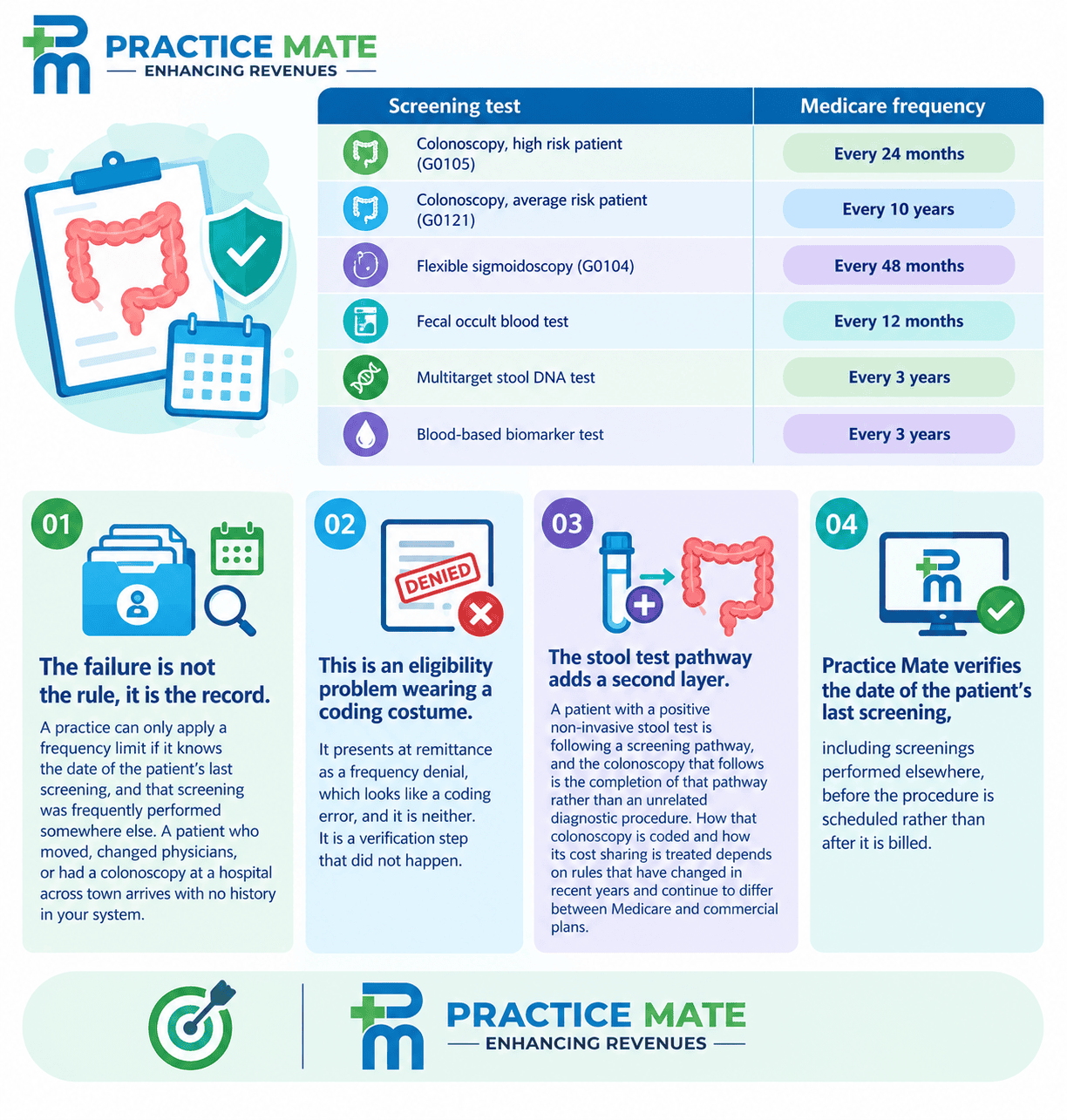
Last screening date confirmed before scheduling, including screenings performed elsewhere, so a frequency denial does not arrive after the supplies are consumed.
Patient responsibility calculated against the correct preventive rules and the current coinsurance percentage, and communicated to the front desk before the patient arrives.
Tracked by payer against plan-specific endoscopy requirements, with authorization confirmed before the procedure rather than chased after it.
The three claims generated by one procedure reconciled against each other, so a denial on the specimen or the sedation does not go unnoticed.
This is the single most consequential billing decision in gastroenterology, it is made mid-procedure, and it changes the code, the modifier and what the patient owes.
For Medicare, a screening colonoscopy is reported with G0105 when the patient is at high risk and G0121 when the patient is at average risk. Flexible sigmoidoscopy screening is G0104. For commercial plans, the screening is generally reported with the standard CPT code and a screening diagnosis.
The moment a lesion is biopsied or removed, the procedure is no longer a screening. It is diagnostic or therapeutic, and the claim has to report the procedure actually performed, using the diagnostic or therapeutic CPT code rather than the screening code.
The modifier is what preserves the patient’s preventive benefit on a procedure that has stopped being preventive.
| Modifier | Payer | What it reports |
|---|---|---|
|
PT |
Medicare |
A colorectal cancer screening test converted to a diagnostic or therapeutic procedure during the same encounter |
|
33 |
Commercial |
A preventive service, used where the encounter began as a preventive screening |
Without one of these on the claim, the payer sees a diagnostic procedure. The preventive cost sharing waiver does not apply, the patient is billed full deductible and coinsurance, and the practice ends up in a billing dispute with someone who was told the procedure was covered in full.
When a planned Medicare colorectal cancer screening becomes diagnostic or therapeutic in the same encounter, the beneficiary owes coinsurance, and that percentage is on a legislated phase-down.
When two endoscopic procedures from the same family are performed in the same session, Medicare does not apply the standard multiple procedure reduction. It applies the multiple endoscopy rule, and the arithmetic is different.
Each endoscopy family has a base endoscopy, the diagnostic procedure that every other procedure in that family includes by definition. When two procedures from the same family are billed together, the higher valued one pays in full, and the second pays the difference between its own value and the value of the base endoscopy. The reasoning is that the practice should not be paid twice for the scope insertion that both procedures share.
A practice expecting a straight fifty percent reduction on the second procedure will see a different number on the remittance and have no way to tell whether it is correct. That uncertainty is what makes endoscopy underpayments so durable: the expected amount was never calculated, so the variance was never visible.
A colonoscopy with a snare polypectomy and a separate biopsy at a different site involves two procedures from the same family. Both are payable. The second one is not payable at its full value, and it is not payable at half its value either. It is payable at its value minus the base.
The expected allowable for the combination has to be calculated before the remittance arrives, so that what posts can be compared against what was owed. That is a payment posting function as much as a coding one, which is why the two have to talk to each other.
Medicare sets how often each colorectal cancer screening test is covered, and a patient who is not yet eligible produces a denial after the procedure has been performed, the sedation given and the supplies used.
Every procedure below carries its own coding decisions, and several carry their own payer policies.
| Procedure area | What the billing hinges on |
|---|---|
|
Screening colonoscopy |
Risk classification, frequency eligibility, and whether the procedure converted |
|
Diagnostic and therapeutic colonoscopy |
Removal technique determines the code. Snare, hot biopsy, cold forceps and ablation are separate codes, not interchangeable. |
|
Upper endoscopy (EGD) |
Diagnostic versus with biopsy, dilation, hemostasis, and the technique documented |
|
Flexible sigmoidoscopy |
Its own screening code and its own frequency interval, separate from colonoscopy |
|
ERCP |
High complexity, frequently authorized, with sphincterotomy, stent placement and stone removal each reported separately |
|
Endoscopic ultrasound |
Radiology and endoscopy components, with fine needle aspiration reported separately |
|
Capsule endoscopy |
Physician interpretation separate from the capsule itself, and frequently authorization-dependent |
|
Motility and diagnostic testing |
Esophageal manometry, pH monitoring and breath testing, each with technical and professional components |
|
Infusion therapy for IBD |
Drug units calculated from the HCPCS descriptor, buy-and-bill inventory exposure, and prior authorization on every biologic |
|
Hemorrhoid and anorectal procedures |
Office-based versus facility setting, which changes the payment substantially |
A colonoscopy that cannot be completed because of an obstruction, inadequate preparation or patient tolerance represents work performed and supplies consumed. There is a defined way to report it, and practices that do not know it either see the claim deny or write the case off entirely.
The billing changes with where the scope is inserted, and so does the reconciliation.
Independent gastroenterology practices.
Office-based procedures, hospital privileges, and the professional claim reconciliation that comes with performing in a setting you do not control.
Multi-provider GI groups.
Provider attribution on shared cases, site-level contracted rates, and reporting readable by physician and by location.
Practice-owned ambulatory surgery centers.
The highest value setting on this list, with a facility claim running on its own payment system alongside the professional claim. Multiple procedure discounting, implant and supply reporting, and covered procedure lists all behave differently from the physician fee schedule.
Hospital outpatient endoscopy.
Professional billing against facility encounter data, with the setting driving a materially different payment than the same case performed in an office or ASC.
IBD and infusion-heavy practices.
Biologic drug units, buy-and-bill working capital exposure, prior authorization on every agent and reauthorization tracking. Structurally the same inventory problem a pediatric practice has with vaccines.
Hepatology.
Its own diagnostic and monitoring patterns, with procedures and drug therapy carrying separate authorization requirements.


Six steps, running from scheduling through monthly reporting.
Eligibility confirmed, last screening date verified including screenings performed elsewhere, frequency eligibility established, prior authorization obtained where the plan requires it.
Patient financial responsibility calculated against the correct preventive rules and the coinsurance percentage in force, and communicated to the front desk.
Coded from the operative note rather than the schedule. Conversion from screening captured, removal technique matched to the code, modifiers applied to what the documentation supports.
Expected allowable calculated for multi-procedure claims, payer-specific edits applied, claim scrubbed and submitted.
Adjustments classified by reason code, payment compared against the expected allowable, underpayments on multi-procedure claims flagged rather than accepted.
Many commercial plans require authorization for diagnostic endoscopy and not for screening. Many require it for capsule endoscopy, ERCP and EUS without exception. A practice contracted with several plans is running several rule sets, and a denial from one tells you nothing about the others.
A diagnostic endoscopy needs a documented indication that meets the payer's coverage policy. Symptoms alone are frequently not sufficient where a policy requires documented failure of conservative management first, and that requirement lives in the payer's policy rather than in any coding manual.
with step therapy requirements, site of care policies that may force a patient from the office to an infusion center, and reauthorization at defined intervals.
What constitutes a complete charge changes with the setting, and so does the reconciliation source.
Every screening colonoscopy checked against the operative note for conversion, with modifier PT or 33 applied to the payer in question. This is the decision that defines GI billing and most billing services never report on it.
Multi-procedure endoscopy claims priced against base endoscopy logic ahead of payment, so an underpayment on the second procedure is a finding rather than an assumption.
Last screening date confirmed, including screenings performed elsewhere, before the patient is scheduled rather than after the supplies are consumed.
Coding, authorization, submission, posting, denials and receivables sit with one team. When a frequency denial traces back to an eligibility step, the same team fixes both ends.
Ask what percentage of your screening colonoscopies converted to diagnostic or therapeutic last quarter, and whether every one of those carried the right modifier. If your biller can answer that from a report in under an hour, your GI billing is in good hands and the case for moving it is about capacity rather than quality. If nobody can answer it, the conversions are not being tracked, which means some of them are not being captured. The second question is about the ASC. If your practice owns or has an interest in an endoscopy center, you have two revenue streams running on two payment systems, and a biller who understands the physician fee schedule but not the ASC payment system is leaving facility revenue on the table.
| In-house | Practice Mate | |
|---|---|---|
|
Cost structure |
Fixed. Salary, benefits, software and training continue whether procedure volume rises or falls. |
Variable, scaled to volume or collections depending on engagement. |
|
GI coding depth |
Depends on one or two people and what they happen to know about conversion, modifiers and endoscopy families. |
Coders assigned to GI, with conversion and multiple endoscopy logic built into the workflow. |
|
Expected allowable calculation |
Rarely performed, because it requires loaded fee schedules and base endoscopy values. |
A standing function with a variance report behind it. |
|
Frequency verification |
Usually limited to what is in your own system. |
Verified against payer eligibility including outside screenings. |
|
Coverage during absence |
Vacation, illness and turnover stop billing while procedure volume continues. |
Continuous. Turnover is our problem, not the practice’s. |
|
Visibility |
Collections reporting, which does not show conversion capture or underpayment. |
Conversion rates, frequency denials, authorization lapses and underpayment variance, monthly. |
Gastroenterology billing is typically priced as a percentage of collections starting from 3%. The variable that drives the rate in this specialty is procedure mix rather than claim count. A practice doing high-volume screening colonoscopy and a practice doing ERCP, EUS and infusion therapy are generating different amounts of work per claim, and pricing that ignores that gets renegotiated within a year.
One thing worth saying plainly, because it is where most GI practices are actually losing money. A billing service that charges a percentage of collections has no financial incentive to find an underpayment on your second endoscopy procedure, because the effort is theirs and the gain is small per claim. Ask specifically how expected allowables are calculated and who reviews the variance. If the answer is vague, that work is not being done.
Onboarding is one meeting, a review of recent claim history, and a team assigned to your account.
The Free GI Claims Review is where most practices start. We examine a recent sample of endoscopy claims and report five specific things:
The findings report belongs to your practice, whatever you decide afterward.

 Faqs
The procedure is reported with the diagnostic or therapeutic CPT code rather than the screening code, and a modifier tells the payer it began as a screening. Medicare uses modifier PT. Commercial plans generally use modifier 33. Without one, the patient's preventive benefit does not apply.
Modifier PT reports that a Medicare colorectal cancer screening test converted to a diagnostic or therapeutic procedure in the same encounter. Modifier 33 identifies a preventive service on commercial claims. They serve a similar purpose for different payers and are not interchangeable.
They are the Medicare screening colonoscopy codes. G0105 reports a screening colonoscopy for a patient at high risk of colorectal cancer. G0121 reports a screening colonoscopy for a patient not meeting high risk criteria. Flexible sigmoidoscopy screening is reported with G0104.
Under Medicare, yes, and the percentage is on a legislated phase-down. Beneficiary coinsurance is 15 percent for 2023 through 2026, 10 percent for 2027 through 2029, and none from 2030 onward. Commercial treatment varies by plan.
Every 24 months for a patient at high risk and every 10 years for a patient at average risk. Flexible sigmoidoscopy is covered every 48 months. A patient screened elsewhere within the interval is not eligible, and the denial arrives after the procedure.
Because the multiple endoscopy rule applies rather than the standard multiple procedure reduction. The second procedure in the same endoscopy family pays the difference between its own value and the value of the base endoscopy, on the reasoning that both procedures share the scope insertion.
Yes. A colonoscopy that could not be completed still represents work performed and supplies used, and there is a defined way to report it. Practices unaware of it either see the claim deny or abandon the charge entirely.
Yes. A practice-owned endoscopy center generates a facility claim on its own payment system alongside the professional claim, with different multiple procedure rules and different supply reporting. Both are billed and reconciled against each other.
Practice Mate reconciles the professional claim against the facility, anesthesia and pathology claims generated by the same procedure. Those claims are frequently submitted by different entities, and a mismatch between them usually surfaces as a patient complaint to your practice.
Yes. Authorization is confirmed against the specific plan before the procedure is scheduled, and reauthorization dates on biologic therapy for inflammatory bowel disease are tracked so a lapse does not stop treatment.
No. Practice Mate works inside the practice management, EHR and endoscopy reporting systems your practice already uses. There is no migration or data conversion required to begin.
[CLIENT: state the confirmed model and range, and what drives the rate, which is procedure mix rather than claim count. No number until confirmed in writing against corrected figures.]
 Faqs
Three to four weeks for most endocrinology practices. We run parallel processing so claims never stop going out. Practices with DSMT program accreditation work or large open AR balances may take five to six weeks.
No. Guaranteed in writing. If your clean claim rate drops below your previous rate in the first 60 days, we work three months at no charge until we close the gap.
We don't issue accreditation — that comes from ADA or ADCES. We do walk you through the application, documentation, program NPI setup, and the billing structure once you're accredited. If you already have accreditation but aren't billing G0108/G0109, we can start within two weeks.
Yes. We audit your CGM patient panel for RPM eligibility, document the 16-day data threshold, set up time-tracking for 99457/99458, and bill monthly. Most practices haven't billed RPM at all — we typically recover six months of eligible RPM revenue in the first 90 days.
Yes. We bill under your NPI and Tax ID. No re-credentialing. No re-enrollment. If you have open credentialing in progress, we manage it as part of onboarding at no additional charge.
Yes. We execute a Business Associate Agreement (BAA) before accessing any patient record. Encrypted transmission. Access-controlled environments. HIPAA-auditable pipeline.
Percentage based on collections. We are paid when you are paid. No flat monthly fees. No per-claim fees that reward volume over accuracy. Written fee proposal before any agreement is signed.