If you run a pediatric practice, your revenue does not fail the way other specialties fail. It fails quietly. A combination vaccine containing four antigens gets billed as one administration unit instead of four, and the claim pays, so nothing ever flags it. A sick visit disappears inside a well visit because modifier 25 was not appended, and the second service is simply never charged. A newborn claim denies because the child was not added to a policy before the enrollment window closed. Practice Mate is a medical billing and revenue cycle management company headquartered in Sugar Land, Texas, working with practices in all 50 states, and pediatrics is one of the specialties we staff and code for directly.


Most specialties bill for treating illness. Pediatrics bills mostly for visits at which nothing is wrong, and on many claims the largest single line is a product the practice already paid for out of its own working capital.
The well-child visit is the workhorse of a pediatric schedule, and preventive medicine codes are selected by the patient's age on the date of service rather than by clinical complexity. That makes the code a data problem before it is a clinical one, and it makes a birthday between booking and visit a denial.
A refrigerator holding tens of thousands of dollars of vaccine is a capital position, not a supply closet. When a dose is coded to the wrong inventory or counted wrong, the practice does not defer that revenue. It loses it on stock it already purchased.
Pediatrics depends on Medicaid more than any other major specialty, which means state program rules, state periodicity schedules, and state managed care organizations decide what a large share of the practice's claims look like. A process built for one state produces denials in another.
Every pediatric claim involves at least three people. The child is rarely the subscriber, is rarely the guarantor, and is routinely covered by two policies at once.

Pediatric claims fail through a short list of repeating mechanisms. The expensive ones do not produce denials, which is why they persist for years without anyone in the practice noticing.
One needle can carry four antigens. Billed as one administration unit, the claim pays cleanly and the practice never learns it under-billed by three units. This is the most expensive invisible error in the specialty.
A legitimate same-day sick and well visit without modifier 25 loses the problem-oriented service entirely. The reverse, appending it by default to force payment, is a compliance exposure rather than a billing technique.
Billing a state supplied dose as private stock is a program compliance problem. Billing privately purchased stock as state supplied forfeits payment for a product the practice bought with its own money.
The code follows the patient’s age on the date of service. A birthday between scheduling and the visit changes the correct code, and the denial that follows reads as a coding error rather than a calendar error.
Developmental and behavioral screening instruments are administered, scored, and filed in the chart. The charge never leaves the encounter. There is no denial because there was never a claim.
The child was covered from birth and then was not, because nobody added them to the policy in time. The claim denies on eligibility.
A child covered by two parents’ plans is billed to the wrong plan first. The denial looks technical. The cause is administrative, and it repeats on every claim until someone fixes the record.
Children move on and off coverage constantly. Eligibility verified at booking is not eligibility on the date of service.
Preventive medicine visits are coded on two variables only: whether the patient is new or established to the practice, and how old the patient is on the date of service. Clinical complexity does not enter the selection.
| Age band | New patient | Established patient |
|---|---|---|
|
Infant, under 1 year |
99381 |
99391 |
|
Early childhood, 1 through 4 years
|
99382 |
99392 |
|
Late childhood, 5 through 11 years
|
99383 |
99393 |
|
Adolescent, 12 through 17 years |
99384 |
99394 |
|
Young adult, 18 through 39 years |
99385 |
99395 |
Three rules decide whether the right code reaches the claim.
Not at scheduling, not at the last visit, not at the start of the plan year. A patient who books at 11 and is seen at 12 moves bands.
A patient seen by a different physician in the same group, in the same specialty, within the relevant lookback period is established. Multi-provider pediatric groups get this wrong more often than solo practices do.
The AAP Bright Futures schedule is the commercial standard. Texas Medicaid uses its own, which is covered in Section
CPT 90460 pays per vaccine component, not per injection. A single combination product given as one shot can generate four separately billable units, and a practice billing one unit per needle is under-billing on every combination product it administers.
| Code | What it reports | When it applies |
|---|---|---|
|
90460
|
Immunization administration through 18 years of age, any route, with counseling by a physician or other qualified health care professional; first or only component of each vaccine |
Patient through 18 years and counseling provided |
|
90461 |
Each additional vaccine or toxoid component administered |
Same encounter, same vaccine, every component after the first |
|
90471 |
Immunization administration, injection; first vaccine |
Counseling not provided, or patient over 18 |
|
90472 |
Each additional vaccine, injection |
Same encounter, each additional vaccine |
|
90473 |
Immunization administration, oral or intranasal; first vaccine |
Non-injectable route |
|
90474 |
Each additional vaccine, oral or intranasal |
Same encounter, each additional non-injectable vaccine |
Two conditions must both hold before the 90460 family applies:
When both hold, report one unit of 90460 for the first component of each vaccine, then one unit of 90461 for every additional component contained in that same vaccine. When either condition fails, the 90471 family applies instead, and that family pays per vaccine rather than per component.
A combination product containing four antigens is administered to a 3-year-old patient, with counseling documented.
The AAP Bright Futures schedule is the commercial standard. Texas Medicaid uses its own, which is covered in Section
TVFC providers enroll through the DSHS immunization portal, and enrollment includes a site visit with a review of vaccine storage units before any vaccine ships. An ImmTrac2 organization code, from the Texas immunization registry, is part of enrollment.
Texas covers CHIP-enrolled children through TVFC by arrangement, which is broader than the base federal eligibility categories.
For a TVFC-eligible patient who is neither Medicaid nor CHIP, DSHS caps the vaccine administration fee the practice may charge. As of the last check of the DSHS provider agreement, that cap is $14.85.
For a Medicaid patient, the practice may not charge for the vaccine, for the administration, or for the office visit associated with the Medicaid service, and accepts the reimbursement set by the state or by the contracted Medicaid health plan.
Coverage for routine childhood vaccines is tied to ACIP recommendations. Federal recommendations changed during 2025 and 2026, a court order stayed those changes, and the earlier recommendations are the ones currently in effect.
The mechanism is stable regardless of who sits on any committee. ACIP issues a recommendation. CDC adopts it. That adoption drives the Medicaid coverage obligation and the VFC resolution determining which vaccines the program supplies. The VFC-ACIP vaccine resolutions are adopted through a process separate from the annual schedule recommendations, which is why the two can move at different times.
WRITE FROM THE VERIFIED POSITION ON THE DAY OF PUBLICATION. Content shape: what was changed, what a court stayed, what the stay means for the schedule currently in force, and the two facts a practice most needs, which are that Medicaid coverage and the Vaccines for Children program are unchanged and that routine childhood vaccines on the recommended schedule remain covered without patient cost sharing. State that the ruling is preliminary and further legal action is expected. Cite the primary record inline
Three things, and all three are billing operations rather than policy positions. Verify current recommendations before placing a vaccine order, because the order commits capital against a coverage position. Confirm plan-level coverage before administering, because plan behavior can lag a recommendation change in either direction. Document the counseling that supports the 90460 family, because that documentation is what separates four billable units from one.
Yes, when the problem addressed is significant and separately identifiable from the preventive service. Report the preventive medicine code plus a problem-oriented office visit code with modifier 25 appended to the office visit, not to the preventive code.
What “significant and separately identifiable” requires is a distinct history, a distinct assessment, and a distinct plan for the problem, documented separately from the preventive template. A minor finding managed inside the preventive visit does not qualify. If the note reads as one encounter, it is one encounter.
Two practical realities sit on top of the rule. The modifier goes on the problem-oriented service, and putting it on the preventive code is a common and avoidable error. And some payers reduce or bundle the second service by policy regardless of documentation quality, which means the right response is to know the policy before the visit rather than to appeal after the remittance.
Practice Mate checks the note for a separately identifiable problem before the modifier goes on, and knows which payers reduce the second service by policy.

Screening performed during a well-child visit is separately billable from the preventive visit itself, and it is the most commonly performed and least commonly charged service in pediatrics.
| Code | Service | Note |
|---|---|---|
|
96110 |
Developmental screening, standardized instrument |
Requires a scored, documented instrument |
|
96127 |
Brief emotional or behavioral assessment |
Standardized instrument, scored and documented |
|
96160 |
Health risk assessment, patient-focused |
Separate from 96161 |
|
96161 |
Health risk assessment, caregiver-focused |
Reported for the caregiver’s benefit to the patient |
|
99173 |
Visual acuity screening, quantitative |
Frequently denied as inclusive to the preventive exam |
|
92551 |
Pure tone hearing screening, air only |
Frequently denied as inclusive to the preventive exam |
|
92587
|
Otoacoustic emissions, limited |
Distinct from pure tone screening |
|
99188 |
Topical fluoride varnish application |
Payer policy and state program rules vary |
Three things determine whether these charges survive. Standardized instrument screening requires a scored, documented instrument, not an informal question set in the narrative. Several of these codes are denied as inclusive to the preventive exam depending on payer policy, which is a policy problem to be known in advance rather than a coding problem to be appealed after. And psychological and neuropsychological testing is reported with the 96130 through 96139 family. CPT 96100 is deleted and is not a valid code, despite still appearing in guidance published elsewhere.

Newborn care is coded by setting and by whether admission and discharge fall on the same date, and the delivery-room services are billed separately from the newborn visit itself.
The newborn care family, 99460 through 99463, splits by place of service and by whether the encounter is an initial visit, a subsequent visit, or an admission and discharge on the same date. Attendance at delivery, 99464, and newborn resuscitation, 99465, are distinct services that are frequently performed and rarely billed, because they get absorbed into the newborn visit by habit. The neonatal and pediatric critical care families, 99468 through 99476, and the intensive care families, 99477 through 99480, are per-day global codes with their own reporting rules. Circumcision is reported with 54150 or 54160 depending on technique.
The newborn claim, though, has a coverage problem before it has a coding problem, and that is the next section.
Practice Mate bills the delivery-room services the record documents, so attendance and resuscitation are not absorbed into the newborn visit.
In pediatrics the patient is rarely the subscriber and often is not the guarantor. A large share of what looks like pediatric coding denials are eligibility failures wearing a coding costume.
A newborn is generally covered under a parent’s policy from birth for a defined enrollment period, after which the child must be formally added to the policy. Claims filed after the child should have been added, but was not, deny on eligibility. The length of that window varies by plan, and treating one number as universal is how practices get caught.
Filing a dependent child as “self” produces a denial that presents as a coding error and is not one. It is a registration field, it is set once, and it repeats on every claim until someone corrects the record.
When a child is covered by two parents’ plans, the plan of the parent whose birthday falls earlier in the calendar year is generally primary. The year of birth is not part of the test, only the month and day. Custody arrangements and court orders can override this, and separated-parent households are where it goes wrong most often.
Statements go to a person who is not the patient and may not be the subscriber. Guarantor records have to be reviewed before a statement leaves the practice, particularly where two households are involved, because a statement sent to the wrong parent is a collection problem and a patient relations problem at the same time.
None of these four resolves itself. Unresolved coordination of benefits is one of the most common reasons pediatric claims sit unpaid past 90 days, at which point the problem has moved from eligibility to collectability.
Practice Mate resolves coordination of benefits before the first claim goes out, so a two-policy child is never billed to the wrong plan first.
Office visit levels are selected either by medical decision making or by total time on the date of the encounter, and pediatric practices under-code more often than they over-code.
The 99202 through 99205 and 99212 through 99215 families carry the two selection paths. Time-based selection includes non-face-to-face work performed on the same calendar date, which in pediatrics covers a meaningful amount of coordination, records review and family communication that goes uncounted. Prolonged services are reported separately when the thresholds are met.
The pattern worth naming is directional. A decade of over-coding enforcement produced systematic under-coding in high-volume primary care, and under-coding generates no denial, no audit letter and no signal of any kind. It is a revenue loss that reports as normal.
Practice Mate reviews E/M level distribution against the documentation and raises systematic under-coding as a finding, not as an accusation.


Some of the most frequently delivered pediatric services are not covered benefits, and the revenue decision on those is a collection policy question rather than a coding question.
Telehealth is reported with modifier 95, and the place of service distinction between 02 and 10 changes the rate, so the setting field is a payment field. After-hours and special services codes 99050, 99051, 99053 and 99058 are legitimately reportable for services delivered outside posted hours or on an emergency basis in the office, and they are almost never billed by practices entitled to them.
School, camp and sports physicals are commonly non-covered when performed outside a periodicity schedule, and in Texas a sports physical specifically does not qualify as a reason for an exception-to-periodicity checkup. Form completion is a separate non-covered service.
Non-covered does not mean unbillable. It means the practice needs a published self-pay policy and a front-desk script that collects at the time of service, and most practices have never closed that loop.
Practice Mate separates non-covered services into a self-pay workflow at intake rather than discovering them at denial.
Practice Mate operates the full pediatric revenue cycle, from eligibility verification before the visit through aged receivables recovery, rather than taking claims after the practice has already coded them.
That distinction is the whole engagement. A billing service that starts at claim submission inherits every error made upstream and can only appeal them. Pediatric revenue cycle management starts before the patient arrives, because that is where the eligibility, coordination of benefits and inventory decisions are made.
Verified against the date of service, with the governing Medicaid program and the primary plan identified before the claim is built.
Tracked by plan against plan-specific lists, including behavioral health and therapy referrals.
Same-day capture reconciled against the day’s schedule, so completed encounters do not go uncharged.
Preventive codes selected against date of service age; E/M level distribution reviewed against documentation.
Components counted against the product administered and matched to the inventory the dose came from.
Documented and scored instruments charged rather than filed.
Payer-specific edits, correct place of service, required diagnosis present including Z23 on immunization encounters.
Contractual and policy reductions separated from denials, so a bundling policy is not mistaken for a coding error.
Worked at root cause, with recurring mechanisms escalated as process findings rather than reworked claim by claim.
Aged claims triaged by collectability and deadline proximity rather than worked top to bottom.
Payer enrollment and revalidation tracked, including state program enrollments where applicable.
Monthly reporting on the metrics that move, plus periodic review of modifier and level distributions.

Six steps, running from eligibility before the visit to compliance review after posting.
Eligibility confirmed against the scheduled date of service, governing program identified, coordination of benefits resolved, prior authorizations checked.
Preventive code selected against date of service age; problem-oriented services identified and evaluated for modifier 25 against the note.
Components counted against each product administered, and each dose matched to state supplied or privately purchased inventory.
Payer-specific scrubbing, required diagnoses confirmed, screening charges attached where documented.
ERA reconciled, policy reductions separated from denials, underpayments flagged against expected allowables.
Denials worked at root cause, recurring mechanisms reported as findings, monthly reporting delivered to the practice.
The whole revenue cycle usually sits with one or two people, which makes it fragile. A single absence stops billing entirely, and the practice absorbs the cost of that person's coding knowledge going stale.
New versus established patient logic, cross-provider scheduling and site-level payer contracting all create errors that solo practices never encounter. Reporting has to be readable by site and by provider or it is not actionable.
Encounter-based reimbursement, VFC eligibility categories that reach further than in private practice, and a wrap-around payment structure that behaves differently from fee for service.
Cardiology, endocrinology, gastroenterology, neurology, pulmonology, allergy and immunology, nephrology, rheumatology, developmental and behavioral pediatrics, adolescent medicine, and neonatology each carry their own procedure sets and prior authorization patterns on top of the preventive base.
No two pediatric practices have the same payer mix, so a standard pediatric billing package fits almost none of them well. The engagement is scoped to five variables, and each one changes what the work actually is.
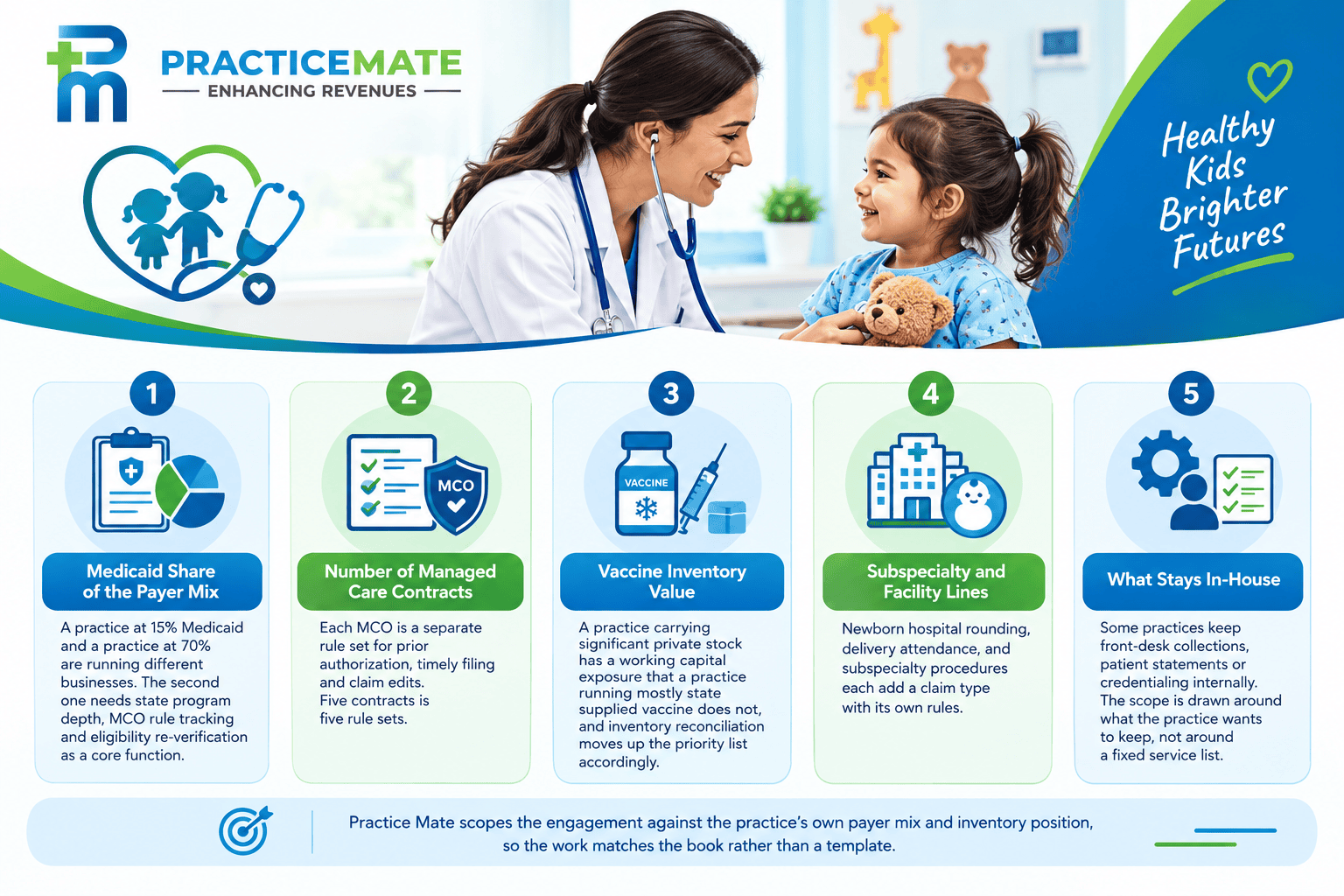
The honest answer is conditional. A small practice with a stable, experienced biller and a light Medicaid mix may not need to move. The calculation changes with three variables: visit volume, Medicaid share of the payer mix, and the dollar value of vaccine inventory the practice carries.
| In-House | Practice Mate | |
|---|---|---|
|
Cost structure |
Fixed. Salary, benefits, software and training continue at the same rate whether volume is up or down. |
Variable. Scales with what is collected. |
|
Pediatric coding depth |
Depends entirely on one or two people and what they happen to know. |
Coders assigned to pediatrics, with vaccine component and preventive age-band logic built into the workflow. |
|
Coverage during absence |
Vacation, illness and turnover stop the revenue cycle. |
Continuous. Turnover is our problem, not the practice’s. |
|
Scalability |
Adding a provider means adding headcount or accepting a backlog. |
Capacity added without a hiring cycle. |
|
Visibility |
Whatever the PM system reports. |
Monthly reporting on level distribution, denial mechanisms and aging. |
Certified coders assigned to pediatrics, one accountable team across the whole revenue cycle, and a billing operation that knows what a state program does to a claim.

Coders working pediatric claims handle well-child and preventive visits, same-day sick and well encounters, vaccine administration and component counting, developmental and behavioral screening, newborn and neonatal care, and age-specific E/M. [CLIENT: state the exact certifications the pediatric coding team holds. These must match the hero trust bar word for word.

Eligibility, coding, submission, posting, denials, receivables, credentialing and reporting sit with one accountable team rather than split across a coding vendor, a billing vendor and an internal collections function. When a denial pattern traces back to an eligibility failure, the same team fixes both ends.

Operating from Sugar Land, Texas means the team works one of the largest state pediatric Medicaid books in the country every day, across STAR, STAR Kids, STAR Health and CHIP, with Texas Health Steps periodicity rules and TVFC inventory rules attached to the claims. That is a statement about depth of program knowledge, not about service area. Practice Mate bills for pediatric practices in all 50 states, and applies the same discipline to every state’s program rules that it applies to its own.

HIPAA compliant, with a business associate agreement executed before any data moves. Monthly reporting on collections, denial mechanisms, aging and coding distribution. [CLIENT: any additional certification or audit claim requires written confirmation and must be stated exactly.]
 Faqs
Two conditions must both hold for the 90460 family: the patient is through 18 years of age on the date of service, and a physician or other qualified health care professional provided counseling. If either fails, the 90471 family applies. The distinction matters because 90460 pays per component while 90471 pays per vaccine.
Report one unit of 90460 for the first component of each vaccine, then one unit of 90461 for every additional component contained in that same vaccine. A four-antigen combination product administered with counseling generates one unit of 90460 and three units of 90461, from a single injection.
Yes, when the problem is significant and separately identifiable from the preventive service. Report the preventive medicine code plus a problem-oriented office visit with modifier 25 appended to the office visit, not to the preventive code. The note must show a distinct history, assessment and plan for the problem.
Bill the administration, not the product, and identify the dose as state supplied using the SL modifier. Administration payment rates are set at state level. In Texas, TVFC administration fees for non-Medicaid, non-CHIP eligible patients are capped by DSHS, and Medicaid patients cannot be charged for the vaccine, the administration, or the associated office visit.
[WRITE FROM THE VERIFIED POSITION ON THE DAY OF PUBLICATION. The two facts a practice needs are that Medicaid coverage and the Vaccines for Children program are unchanged, and that routine childhood vaccines on the recommended schedule remain covered without patient cost sharing. Note that the governing ruling is preliminary. Report only, no evaluation, and carry the last-checked date.]
Coverage generally runs from birth for a defined enrollment period, after which the child must be added to the policy. Claims filed after the child should have been added will deny on eligibility. The length of that window varies by plan, so it should be confirmed against the specific policy rather than assumed.
Generally the plan of the parent whose birthday falls earlier in the calendar year. Only the month and day count; the year of birth is not part of the test. Custody arrangements and court orders can override the rule, which is why guarantor and coordination of benefits records need review in separated-parent households.
EPSDT is the Medicaid benefit entitling enrolled children to screening, diagnostic and treatment services, on a broader coverage standard than commercial preventive benefits. States set their own periodicity schedules and program names. In Texas it is Texas Health Steps, which covers birth through 20 years of age.
Frequently not, when performed outside the periodicity schedule. In Texas, a sports physical does not qualify as a reason for an exception-to-periodicity checkup. Non-covered does not mean unbillable: it means the practice needs a published self-pay policy and a front-desk process to collect at the time of service.
[CLIENT: percentage of collections. State the confirmed range and what drives the rate, which is claim volume, payer mix complexity and scope of services. No number appears here until it is confirmed in writing against corrected figures.]
 Faqs
Three to four weeks for most endocrinology practices. We run parallel processing so claims never stop going out. Practices with DSMT program accreditation work or large open AR balances may take five to six weeks.
No. Guaranteed in writing. If your clean claim rate drops below your previous rate in the first 60 days, we work three months at no charge until we close the gap.
We don't issue accreditation — that comes from ADA or ADCES. We do walk you through the application, documentation, program NPI setup, and the billing structure once you're accredited. If you already have accreditation but aren't billing G0108/G0109, we can start within two weeks.
Yes. We audit your CGM patient panel for RPM eligibility, document the 16-day data threshold, set up time-tracking for 99457/99458, and bill monthly. Most practices haven't billed RPM at all — we typically recover six months of eligible RPM revenue in the first 90 days.
Yes. We bill under your NPI and Tax ID. No re-credentialing. No re-enrollment. If you have open credentialing in progress, we manage it as part of onboarding at no additional charge.
Yes. We execute a Business Associate Agreement (BAA) before accessing any patient record. Encrypted transmission. Access-controlled environments. HIPAA-auditable pipeline.
Percentage based on collections. We are paid when you are paid. No flat monthly fees. No per-claim fees that reward volume over accuracy. Written fee proposal before any agreement is signed.