
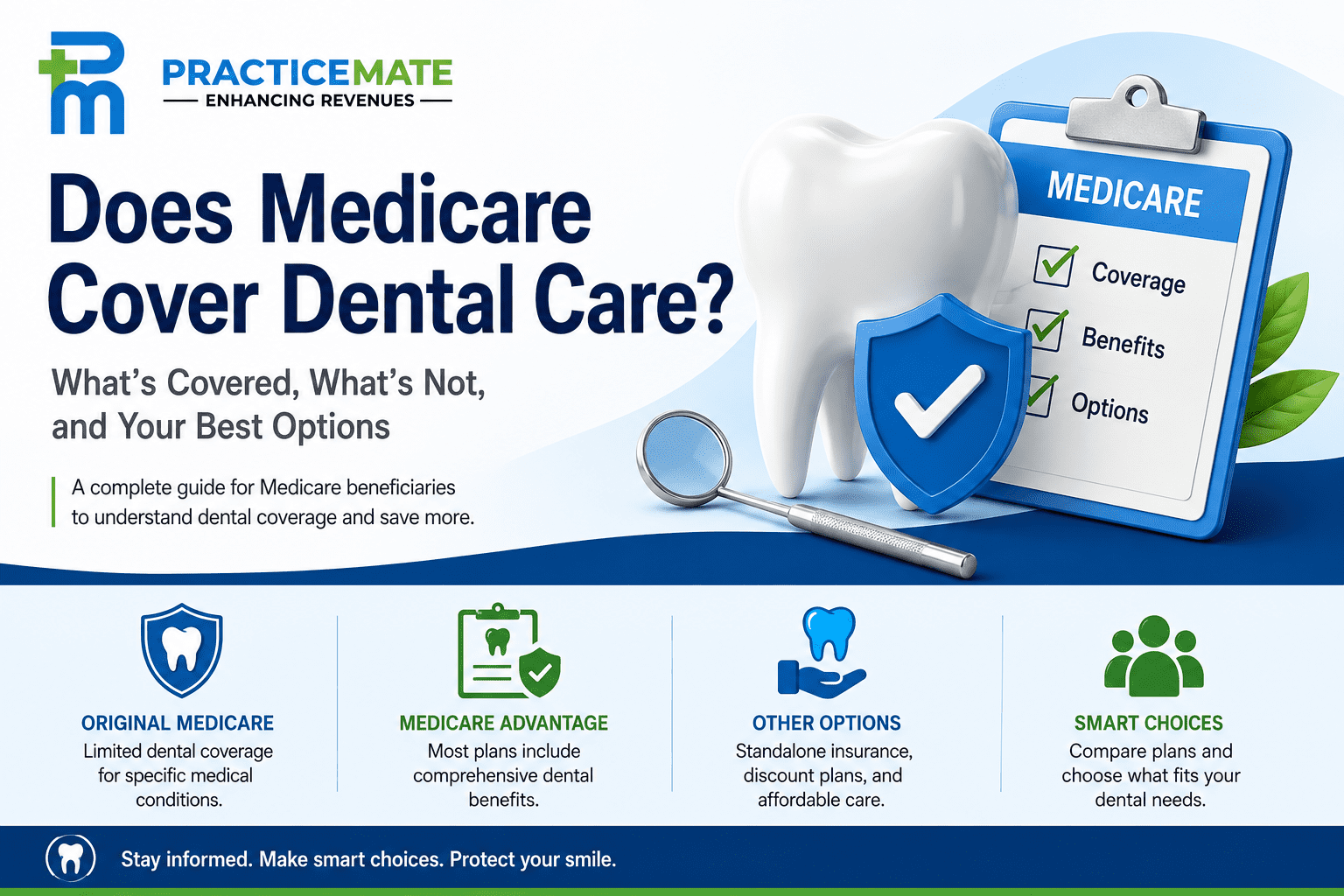
Does Medicare Cover Dental Care?
The short answer is Original Medicare (Parts A and B) does not cover routine dental care.
This gap has existed since Medicare was created in 1965, and it remains one of the most significant blind spots in the program.
But that is not the whole story. Medicare does cover certain dental procedures when they are medically necessary as part of another covered treatment.
And Medicare Advantage plans frequently include dental benefits that Original Medicare does not. Understanding exactly what is covered, what is not, and how to access dental care as a Medicare beneficiary requires looking at all three categories separately.
Original Medicare (Parts A and B): What Is Covered
Original Medicare covers dental services only in very narrow, specific circumstances. The general rule is straightforward: if the dental procedure is needed to treat a separate medical condition or to make another Medicare-covered service possible, Medicare may pay. Routine oral health maintenance is not covered.
Part A Coverage (Hospital Insurance)
Medicare Part A covers dental services when a patient receives them as an inpatient in a hospital or skilled nursing facility. Even then, coverage depends on whether the dental procedure is directly related to a covered medical condition.
Examples of Part A coverage include dental services required before an organ transplant, cardiac valve replacement, or valvuloplasty procedure. Medicare also covers dental ridge reconstruction performed as part of or after surgical removal of a tumor, treatment for jaw fractures, and dental splints for dislocated jaw joints.
Part B Coverage (Medical Insurance)
Medicare Part B covers dental services that are inextricably linked to a covered medical procedure. The key standard is medical necessity. If the dental work is required to make another Medicare-covered service safe or effective, Part B may pay.
For example, Medicare covers oral examinations performed as part of a complete workup before cancer treatment that could affect the jaw. Extractions done in preparation for radiation treatment of the jaw are covered because untreated dental infections could complicate cancer therapy.
What Original Medicare Does Not Cover
Original Medicare does not cover routine dental care under any circumstances. The list of excluded services includes annual exams and cleanings, diagnostic and bitewing x-rays for routine purposes, fillings, tooth extractions for decay or routine problems, root canals, dental implants, crowns and bridges, dentures, periodontal treatment, and any cosmetic dental procedures.
Recent Changes: ESRD Dental Coverage
Beginning in 2025, Medicare expanded dental coverage for individuals undergoing dialysis for end-stage renal disease. Medicare now covers dental and oral examinations as well as necessary treatments for ESRD patients. This expansion applies regardless of whether the patient opts for dialysis or a kidney transplant.
Medicare Advantage (Part C): The Primary Path to Dental Benefits
Medicare Advantage plans, also known as Part C, are offered by private insurance companies approved by Medicare. These plans bundle Parts A and B (and usually Part D) into a single plan, and the majority include additional benefits that Original Medicare does not offer. Dental coverage is among the most common supplemental benefits.
According to the American Dental Association, up to ninety-seven percent of Medicare Advantage plans offer dental benefits. The average Medicare beneficiary has access to approximately forty-two different Medicare Advantage plans, giving most beneficiaries multiple options for dental coverage.
Types of Dental Coverage Available
Medicare Advantage dental benefits fall into three general categories. Preventive-only plans cover basic services like two cleanings per year, two oral examinations per year, and bitewing x-rays. Some preventive plans also include fluoride treatments and sealants.
Comprehensive plans cover preventive services plus basic procedures like fillings and simple extractions, and sometimes major procedures like crowns, bridges, root canals, and dentures.
The exact coverage varies significantly between plans. One plan may cover dentures at fifty percent after a deductible while another plan does not cover dentures at all. Coverage limits, waiting periods, deductibles, and coinsurance percentages differ across insurers and even across plans from the same insurer.
Annual Maximums and Cost Sharing
Most Medicare Advantage dental plans impose annual maximum benefit limits. A typical annual maximum ranges from 1,000to1,000to3,000 per year. Some plans pay covered services at one hundred percent up to the annual maximum. Others require coinsurance, meaning the patient pays a percentage of each service. For major procedures like crowns and dentures, coinsurance of fifty percent is common.
Waiting periods also apply to some plans, particularly for major procedures. A twelve-month waiting period for crowns, bridges, dentures, and implants is standard across many plans.
Examples from a Representative Plan
A typical Medicare Advantage dental benefit might include the following structure. Preventive services such as two oral examinations per year, two cleanings per year, and two bitewing x-rays per year are covered at one hundred percent with no deductible. Basic services such as fillings, simple extractions, and root canals are covered at eighty percent after a fifty-dollar deductible. Major services such as crowns, bridges, dentures, and implants are covered at fifty percent after a fifty-dollar deductible and a twelve-month waiting period.
Medicare Advantage plans are not uniform. A UnitedHealthcare plan in one state may have different coverage terms than a UnitedHealthcare plan in another state. An Aetna plan that covers implants may charge a different coinsurance percentage than a Humana plan that does not cover implants at all.
The only reliable way to understand a specific plan’s dental benefits is to review its Evidence of Coverage document. Verify eligibility and reconfirm benefits for each patient at every appointment, as plans can change their coverage from year to year.
Standalone Dental Insurance
Medicare beneficiaries who remain in Original Medicare and do not enroll in a Medicare Advantage plan can purchase standalone dental insurance. These plans are separate from Medicare and are offered by private dental insurance carriers.
Standalone dental insurance typically costs between 20and20and60 per month . Plans usually cover preventive care at one hundred percent, basic procedures at seventy to eighty percent, and major procedures at fifty percent. Annual maximums are common, typically ranging from 1,000to1,000to2,000. Waiting periods for major procedures apply to most plans.
Standalone dental plans operate independently of Medicare. The beneficiary pays premiums directly to the insurance carrier. The plan reimburses the dentist according to its fee schedule, and the patient pays any remaining balance.
Dental Discount Plans
Dental discount plans are another option for Medicare beneficiaries. Unlike insurance, discount plans do not pay claims. Instead, they provide access to a network of dentists who agree to charge reduced fees to plan members.
Discount plans typically cost less than insurance, often 10to10to20 per month. They have no annual maximums and no waiting periods. The tradeoff is that the patient pays the discounted fee directly to the dentist at the time of service. The discount plan does not reimburse anything.
Discount plans work well for patients who need predictable, ongoing dental care and want to avoid insurance complexities. However, the discounts vary by procedure and by provider, and not all dentists accept discount plans.
Other Options for Affordable Dental Care
Community Health Centers
Federally qualified health centers provide dental services on a sliding fee scale based on income. Patients pay what they can afford. These centers are located in medically underserved areas and serve all patients regardless of insurance status.
Dental Schools
Dental schools offer reduced-cost dental care provided by students under faculty supervision. Treatment is thorough because every procedure is reviewed by experienced faculty. Appointments take longer than private practice visits, but the cost savings can be substantial.
Medicaid for Dual Eligibles
Beneficiaries who qualify for both Medicare and Medicaid, sometimes called dual eligibles, may receive dental coverage through their state Medicaid program. Medicaid dental benefits vary by state. Some states provide comprehensive dental coverage for adults. Others provide emergency-only services. Check with the state Medicaid office for specific benefits.
Provider Payment Plans
Many dental offices offer in-house payment plans for patients without adequate insurance coverage. These arrangements allow patients to pay for treatment in monthly installments rather than as a single lump sum.
The Advance Beneficiary Notice (ABN) for Dental Providers
For dental offices treating Medicare patients, the Advance Beneficiary Notice of Noncoverage (ABN), Form CMS-R-131, is a critical compliance tool. The ABN is a written notice given to a Medicare beneficiary before providing a service that Medicare may not cover in that specific case.
When to Use the ABN?
The ABN is appropriate when a service is normally covered by Medicare but will not be covered for this particular patient due to specific circumstances. The classic example in dental practice involves oral appliances for obstructive sleep apnea. Medicare does cover oral appliances for sleep apnea, but only devices that meet very specific mechanical criteria. If the device the dentist prescribes does not meet every criterion, an ABN is required.
The ABN must be given before the service is provided. Handing someone an ABN after treatment does not protect the provider’s ability to bill the patient. The form must be written in plain language that the patient can understand, must be specific about which service may not be covered and why, and must be signed and dated by the patient.
New ABN Form for 2026
On March 13, 2026, the Office of Management and Budget approved a new version of the ABN (CMS-R-131). The old version may be used only through May 12, 2026. After that date, the expired version will not be accepted. Dental offices must download the new form from CMS.gov and replace all saved templates and printed versions immediately.
What the ABN Is Not
The ABN is not a blanket form for every Medicare patient. Giving an ABN to every patient over sixty-five “just in case” is not what the form is for and can create its own compliance problems. The ABN is designed for services that Medicare normally covers but will not cover in this specific case. Routine dental services that Medicare never covers do not require an ABN because there is no reasonable expectation of coverage.
Coding and Billing Considerations for Dental Offices
For dental offices that provide medically necessary services to Medicare patients, proper coding and billing are essential. Services that qualify for Medicare coverage must be billed with appropriate medical diagnosis codes (ICD-10) rather than dental procedure codes (CDT).
The magic words are medical necessity. Documentation must clearly establish why the dental service is required for the treatment of a covered medical condition. For a patient undergoing cancer treatment, the record must show that the oral examination is needed to assess and manage treatment-related complications. For a patient with a jaw fracture, the record must document the trauma and the need for surgical intervention.
Medicare Administrative Contractors process claims for dental services that meet coverage criteria. Each MAC may have slightly different local coverage determinations for specific procedures. Dental offices should review their MAC’s policies for the services they commonly provide.
What Does Not Work
Routine Dental Care Through Original Medicare
Original Medicare will not pay for routine cleanings, exams, fillings, or dentures. No amount of documentation or appeals changes this rule. The exclusion is clear and has been part of the Medicare program since its inception.
Medicare Supplement (Medigap) Dental Coverage
Medigap plans sold after 2006 do not include dental coverage. Some older Medigap plans may have included limited dental benefits, but these plans are no longer available to new enrollees. Medigap is designed to cover Medicare cost sharing, not to add new benefits like dental.
Practical Steps for Beneficiaries
Step One: Determine Which Path You Are On
If you are enrolled in Original Medicare (Parts A and B only), you have no routine dental coverage. Your options are standalone dental insurance, a dental discount plan, or paying out of pocket.
If you are enrolled in a Medicare Advantage plan, review your plan’s Evidence of Coverage document. Look for the section on dental benefits. Note the annual maximum, the coinsurance percentages, the waiting periods, and the network restrictions.
Step Two: Verify Network Participation
If your Medicare Advantage plan has a dental network, confirm that your preferred dentist participates. Some plans require you to see an in-network dentist to receive the full benefit. Out-of-network care may not be covered or may be covered at a lower rate.
Step Three: Compare Options During Open Enrollment
Medicare Open Enrollment runs from October 15 to December 7 each year. During this period, beneficiaries can switch between Original Medicare and Medicare Advantage, or change Medicare Advantage plans. This is the time to compare dental benefits across plans and choose the option that best fits your dental needs.
Conclusion
Medicare does not cover routine dentistry, but Medicare Advantage frequently does. Beneficiaries who want dental coverage should prioritize Medicare Advantage plans during open enrollment and review each plan’s dental benefits carefully before enrolling.
